
Guide
Futures Initial Margin vs Maintenance Margin
Initial margin opens the position. Maintenance margin is the lower level that must remain while the position stays open.
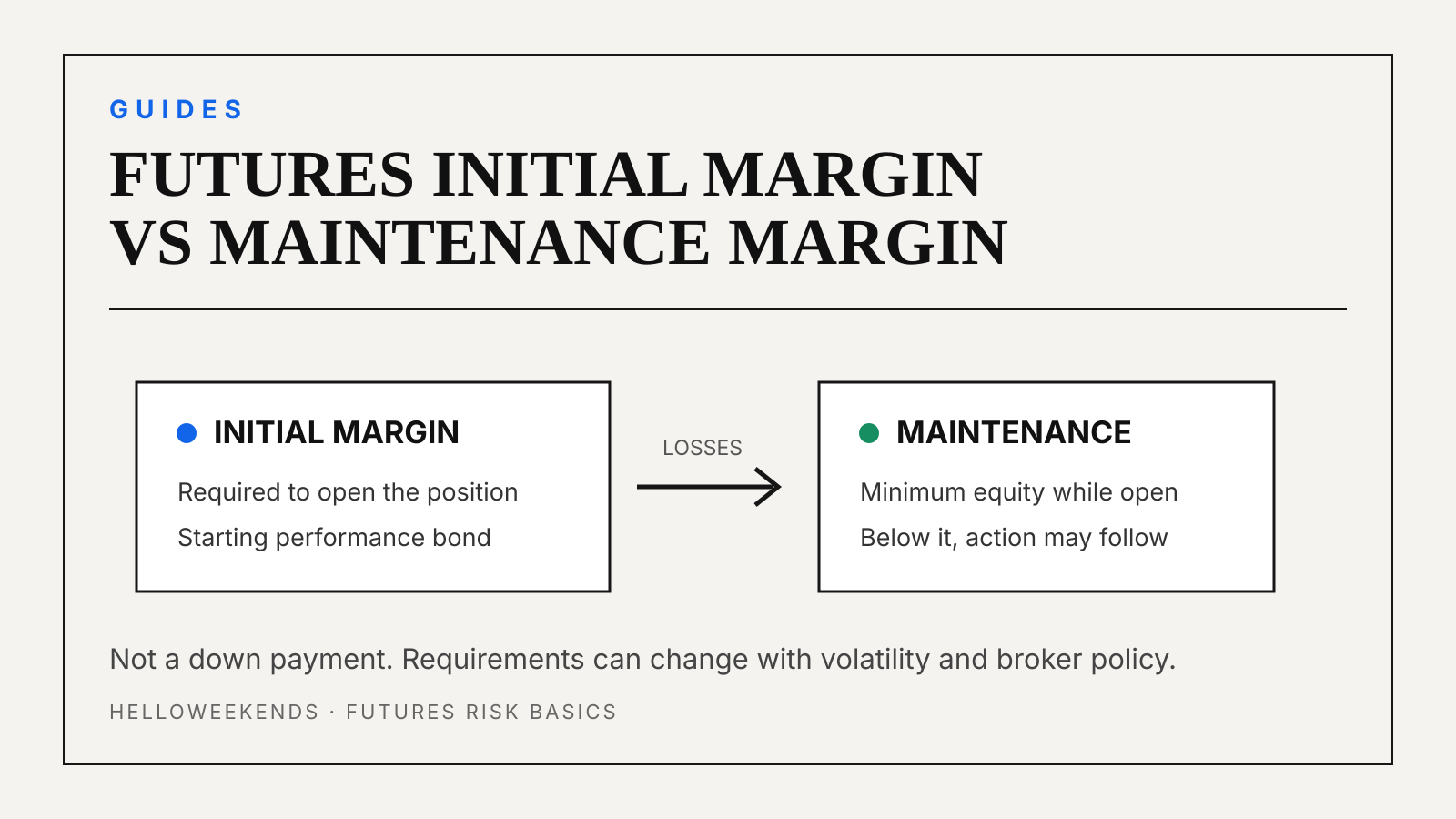
Futures margin is not a down payment on the contract and it is not the same as borrowing money to buy shares. CME describes it as money held as a performance bond. It supports the trader's obligation to cover losses as the contract is marked to market each day.
Two levels matter most. Initial margin is the amount normally required to open a position. Maintenance margin is the lower minimum that must remain in the account while the position is open. If losses push account equity below maintenance, the broker can require enough money to restore the account to the initial level.
The short version
| Term | When it matters | What it does |
|---|---|---|
| Initial margin | Before a position is opened | Sets the starting performance-bond requirement |
| Maintenance margin | After the position is open | Sets the minimum equity level that must be maintained |
| Margin call | When equity drops below maintenance | Requires funds, a position reduction or closure under the broker's rules |
Why futures margin moves every day
Futures accounts are marked to market. Gains and losses are credited or debited as prices change, so the account balance can move even when the trader has not closed the position. The CFTC notes that the futures commission merchant may require more margin than the exchange minimum. That means two brokers can impose different house requirements for the same contract.
Margin levels can also change when volatility rises. CME says exchanges and clearing houses monitor market conditions and may adjust performance-bond requirements. A trader who had enough funds yesterday can face a higher requirement today even without adding a new position.
A simple example
Assume one contract has an initial margin requirement of $6,000 and a maintenance requirement of $5,500. The trader deposits $6,000 and opens the position. A $300 loss leaves $5,700, which is still above maintenance. A further $400 loss leaves $5,300, below the $5,500 maintenance level.
At that point the relevant call is generally to restore the account to the $6,000 initial requirement, not merely to bring it back to $5,500. The trader may be able to deposit funds or reduce the position, but the broker's agreement controls the timing and available choices. Firms can liquidate positions when required funds are not provided.
Exchange minimums and broker house margin
The exchange publishes performance-bond requirements, but they are not a promise that every customer can trade at that level. A broker can require a larger deposit based on volatility, concentration, account size, trading strategy or its own risk policy.
Intraday margin is another broker policy. Some firms permit a lower amount while a position is opened and closed within a specified session, then require the full overnight amount before the cutoff. That lower intraday figure is not a new exchange definition of initial or maintenance margin. It is a firm-level risk setting, and the deadline can vary by product and broker.
How margin interacts with a prop account
A futures prop firm may show buying power, maximum contracts or an internal margin limit instead of asking the trader to post exchange margin directly. The underlying futures still carry clearing and broker requirements, but the trader also has to comply with the firm's loss, position and session rules.
Do not treat a prop firm's maximum contract count as proof that every permitted combination has the same risk. Contracts have different tick values and margin requirements. A position that fits the account's contract limit can still create a large dollar swing or violate a firm's risk controls.
What to check before the order
- the exchange's current initial and maintenance requirement for the exact contract month;
- the broker's current house margin, including overnight and concentration add-ons;
- the intraday cutoff and what happens if a position remains open past it;
- the account's available funds after open losses and other positions;
- the firm's liquidation and margin-call policy; and
- scheduled events that could lead the broker or exchange to raise requirements.
Margin is a changing risk requirement, not a fixed cost of admission. Check it near the time of the trade and leave room for price moves, house add-ons and requirement changes.
Related guides
Margin tells you how much financial capacity is required, while the order determines how you enter or exit. Review our guide to futures order types. For daily account changes, see how the futures settlement price is set. Volume and open interest are separate measures covered in our volume versus open-interest guide.