Prop Firm Drawdown After Payout: What Changes
A payout can cut room left to trade. The loss floor may change too. Check both rules for your own plan at its new stage.
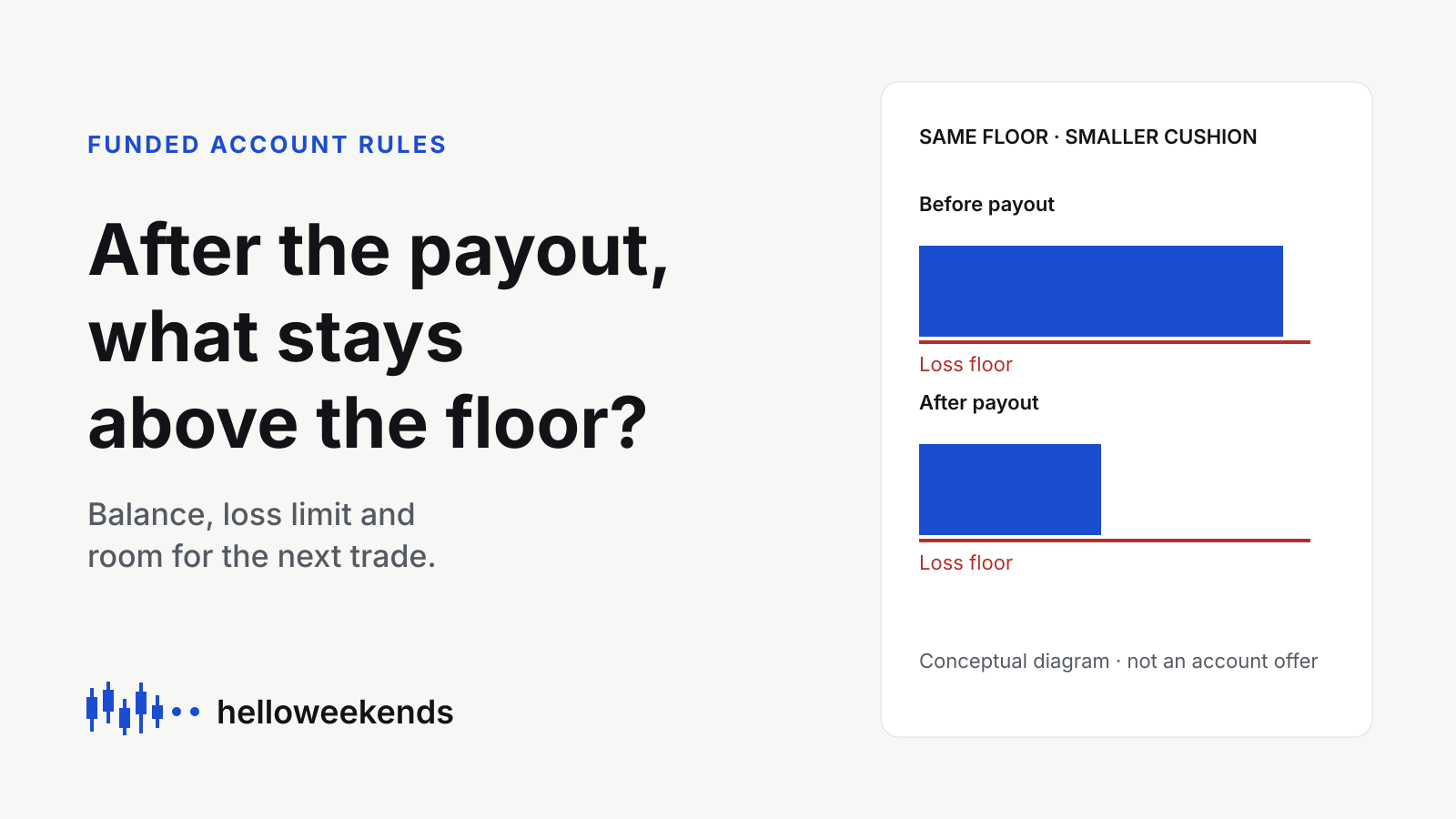
Prop firm drawdown after payout depends on the account’s loss-limit rules and the balance left after the withdrawal. A payout can reduce your room to take another loss even when the limit itself stops moving. Check the funded account type, the post-payout floor and the deduction shown in your dashboard before using the remaining balance to size another trade.
This guide separates the arithmetic from the rules firms attach to it. The examples are hypothetical; they are not trading recommendations or results from accounts we traded. Firm policies were checked on October 7, 2026.
The balance and the loss limit are different numbers
The nominal account size tells you little about the money you can lose after taking a payout. A simulated account with $50,000 of buying power does not necessarily contain $50,000 of earned profits or loss capacity. Topstep’s Express Funded Account parameters explain that an XFA starts with a $0 balance while retaining its selected buying power.
For a simple balance-based illustration, subtract the applicable loss floor from the balance remaining after the payout. That gives the distance to the floor at that moment. It does not describe every firm’s intraday calculation: unrealized profit, equity tracking and fees can change which numbers matter.
Suppose an account has $4,000 in earned balance, its applicable floor is $0, and a $2,000 payout is deducted from the account. The remaining balance is $2,000. With the same floor, the distance to it has fallen from $4,000 to $2,000. The payout did not double the allowable risk merely because it was approved.
If the firm changes the floor when the payout occurs, calculate again with that new floor. A balance of $2,000 above a $100 floor leaves $1,900 of distance, not $2,000. These are arithmetic examples, not quoted account offers.
Read our trailing drawdown guide for the distinction between a moving limit and a fixed floor. The exact trigger remains the firm’s account rule, not this subtraction alone.
Topstep: the first XFA payout fixes the MLL at zero
Topstep’s current payout policy says that after the first payout, the Maximum Loss Limit, or MLL, is set to $0 permanently. The balance you leave behind becomes the relevant cushion above that limit. A subsequent withdrawal reduces that cushion.
That is why “the drawdown has stopped trailing” and “I have plenty of room to trade” are different conclusions. A fixed zero floor can coexist with a small remaining balance. The account still has to stay within its applicable loss rule.
Topstep also says a payout can change the Scaling Plan tier. If the balance after the deduction falls into a lower tier, the maximum permitted contract size can fall with it. Check both the loss limit and the permitted size after the payout. Looking only at the amount paid to your bank misses the account-side consequence.
This applies to the account type described in the policy. An XFA is a simulated funded account; Topstep can pay real money based on simulated results. Its nominal buying power should not be mistaken for withdrawable cash.
Qualification resets are separate from the loss floor
Topstep offers Standard and Consistency XFA paths. The current payout policy gives them different qualification tests: the Standard path requires five qualifying winning days, while the Consistency path requires three days and a 40% consistency target.
The XFA parameters say the consistency calculation resets after a payout. That reset concerns qualification for the next payout. It does not restore the balance that was withdrawn, increase the remaining loss cushion or switch an account to another path.
Keep three records apart:
| Record | What it answers |
|---|---|
| Remaining account balance | What is left after the deduction? |
| Applicable MLL and size tier | Where is the loss boundary, and what size is permitted? |
| Next-payout qualification window | Which new trading days or profit distribution count? |
Current size-dependent payout caps and any applicable offer conditions are on the firm’s policy page. Verify the terms for your account before requesting an amount; a headline cap is not a promise that every account can withdraw it.
A live funded account is a different case
Do not carry the XFA interpretation into a Topstep Live Funded Account without checking the live rules. Topstep’s payout policy describes a separate route: after 30 qualifying winning days, a live trader can unlock daily payouts and access up to 100% of the balance.
The policy expressly warns that a 100% live payout closes the Live Funded Account because the balance reaches the Maximum Loss Limit. That is an account-closure consequence, not a general invitation to withdraw the entire balance and keep trading.
The same page distinguishes processing behavior between simulated and live accounts. Use the status and deduction on your own account rather than assuming every request leaves immediately available trading capacity. Our Topstep profile links the firm-specific rules and payout references.
My Funded Futures: identify the plan first
My Funded Futures’ payout overview, dated August 25, 2026, describes Rapid, Builder and Pro separately. A buffer or post-payout rule quoted for one should not be assigned to all three.
For Rapid, the overview lists required buffers of $2,100 for the $50,000 plan, $3,100 for $100,000 and $4,600 for $150,000, with a minimum withdrawal of $500 after the buffer. Eligibility for a request does not tell you how much balance you will retain afterward. Check the applicable intraday or end-of-day account rules as well as this payout overview.
For Builder, the overview explicitly says the Max Loss Limit resets to $100 after the first payout. Recalculate the remaining balance against that stated floor. The plan also has its own consistency condition and request limits, so the amount available for a payout cannot be inferred from the loss floor alone.
For Pro, the same page describes a different cadence and buffer arrangement, including a withdrawal provision before fully clearing the buffer. The overview does not make Builder’s $100 reset a universal rule for Pro or Rapid. If a dashboard label is unclear, obtain the applicable plan rule before treating the floor as fixed.
Our My Funded Futures profile is the starting point for the related plan references.
A short check before and after the request
Before requesting a payout, identify the firm, plan, account stage and exact policy that applies to it. Record the balance, current loss threshold and any threshold change the payout triggers. Then calculate the balance you expect to retain after the account deduction.
After the request is processed, compare that expectation with the dashboard. Check the permitted contract size and whether the next qualification window has reset. Include posted trading costs when assessing the balance. Do not assume the amount received in your bank equals the account deduction if a profit split or processing charge applies.
This check is useful because a payout has two consequences: money leaves the trading account, and an account rule may change at the same time. Recording only the external payment leaves the second consequence unexamined.
Questions
Does a payout always reset a prop firm drawdown?
No. Rules differ by firm, plan and account stage. Topstep describes a zero MLL after the first XFA payout; My Funded Futures describes a $100 post-first-payout MLL for Builder. Neither statement can be generalized to every funded account.
Does fixed drawdown mean the remaining balance is safe to withdraw?
No. A fixed floor still limits how much loss the remaining account can absorb. Payout eligibility, maximum request size and continued trading capacity are separate questions.
Can a full payout close an account?
Yes, where the firm’s rule says so. Topstep specifically describes closure after a 100% payout from an eligible Live Funded Account. Check the rule for your own account rather than applying that live example to a simulated plan.
Sources
Checked October 7, 2026.