A prop firm counts trading days before it lets you pass a test or ask for pay; its other rules can still add more days.
The number looks simple, but it is only one part of the rule. A firm may also apply a consistency formula, define its own session boundary, or require a minimum profit on each qualifying day.
Sources checked October 18, 2026. Firm rules change. Confirm the current requirement on the linked official page before trading or paying for an account.
An evaluation minimum tells you how many trading days must be on the account before the firm can mark the evaluation as passed. A payout minimum controls when money can be requested from a simulated funded or live account. The same firm can use different counts for those two stages.
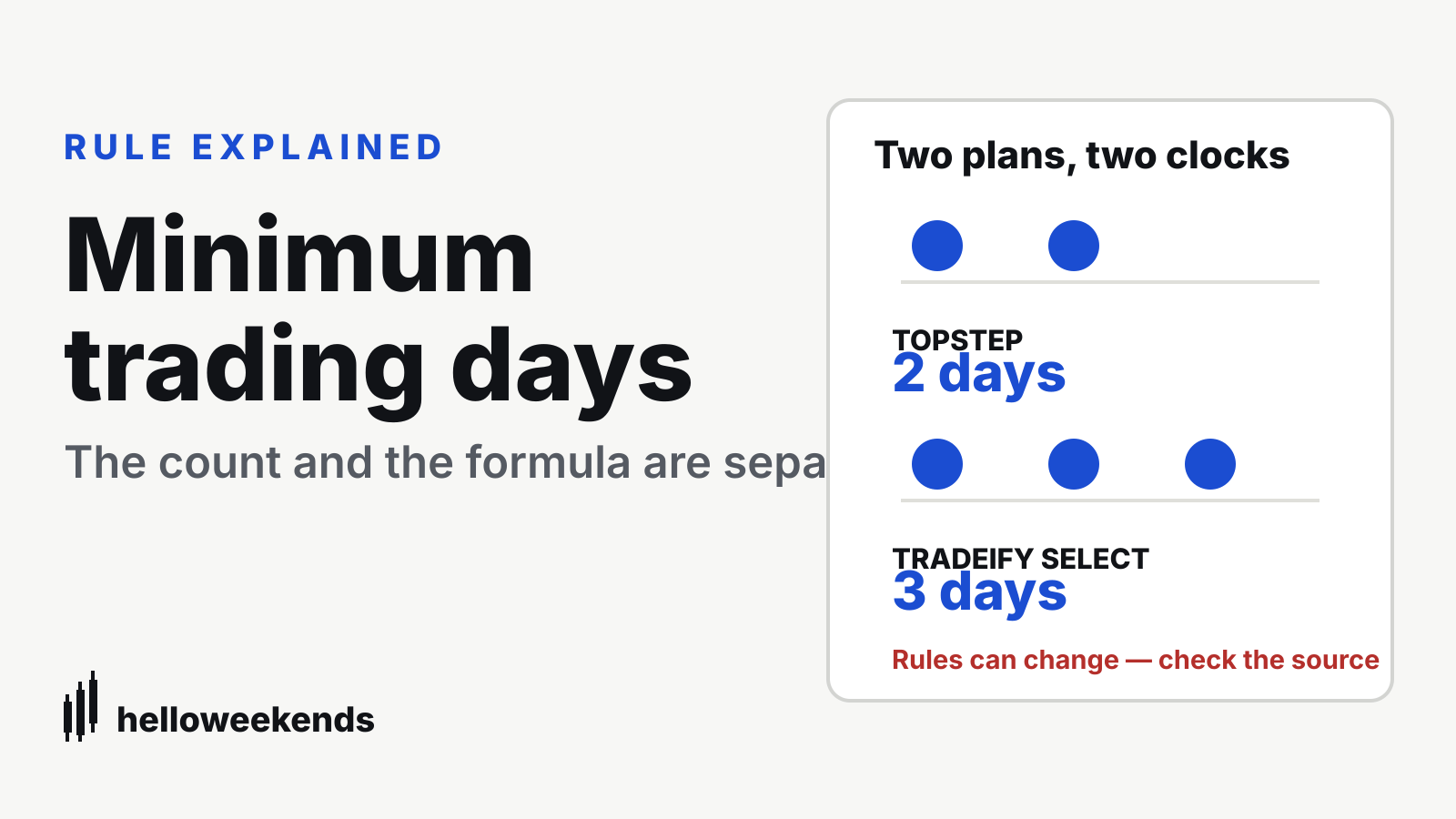
Topstep, for example, says its current Trading Combine can be passed in as few as two days. Its page also says the largest day should remain below 55% of the profit target. That formula can force the total target higher after an outsized day, even after the two-day count is met. See the official Topstep Trading Combine parameters.
Tradeify separates its plans. Its Growth evaluation has a one-day minimum and no consistency rule. Its Select evaluation normally needs at least three trading days because no single day may exceed 40% of total profit. Tradeify says a paid 50% consistency add-on can make a two-day Select pass possible. See the official Growth evaluation rules and Select evaluation rules.
Those examples show why a comparison must identify the exact plan. “Topstep” or “Tradeify” alone is not enough.
A minimum-day counter may require only one trade, or it may require a specified profit. Firms can use several labels:
Do not assume these terms are interchangeable. A three-day activity requirement can be easier to meet than five winning days with a dollar threshold.
The session boundary matters too. Topstep says its trading day runs from 5:00 p.m. CT through 3:10 p.m. CT the next calendar day. Tradeify describes a trading day as 6:00 p.m. ET through 5:00 p.m. ET the next day. A Monday evening trade may therefore count toward Tuesday’s session.
For a fuller explanation, read what counts as a trading day.
A consistency percentage limits how much one day may contribute to total profit. If the cap is 40%, one day cannot be more than 40% of the total used for the calculation.
Suppose the largest day is $1,300. Under a 40% rule, the account needs at least $3,250 in total profit:
$1,300 ÷ 0.40 = $3,250
Reaching a $3,000 nominal profit target would not be enough in that example. The day count might already show three, but the consistency test would still be short. The firm may require more profit rather than rejecting the big day.
Topstep uses a different current formula in the Trading Combine: its best day should stay below 55% of the profit target. Read consistency rules for the calculation and the difference between a target and a hard breach.
Before buying an evaluation, record these fields from the official plan page:
This checklist separates a fast-looking plan from one that is actually fast for your trading pattern. It also prevents a common mistake: comparing one firm’s evaluation rule with another firm’s payout rule.
A one-day pass does not make an evaluation safer. It only changes the earliest possible completion. Maximum loss, daily loss, position size and consistency can still fail the account. An evaluation is a paid service using simulated trading; most participants do not pass.
Use the futures prop firm comparison for dated account facts, then open the official rule page before purchase. This is general information, not investment advice.
Some plans allow it. Tradeify’s current Growth evaluation says it can pass in one trading day because it has no consistency requirement. Other plans impose a longer minimum or an effective minimum through consistency.
Not always. The account may also need the minimum day count, remain inside drawdown limits and satisfy consistency.
No. Evaluation activity and funded-account payout eligibility are separate stages unless the firm explicitly says otherwise.
Often no. Futures sessions commonly begin in the evening and are credited to the following trading day. Use the firm’s own session definition.
The linked Topstep and Tradeify pages were checked on October 18, 2026.
