A firm counts a trading day by its session clock, often evening to evening; midnight alone usually does not begin a new day for you.
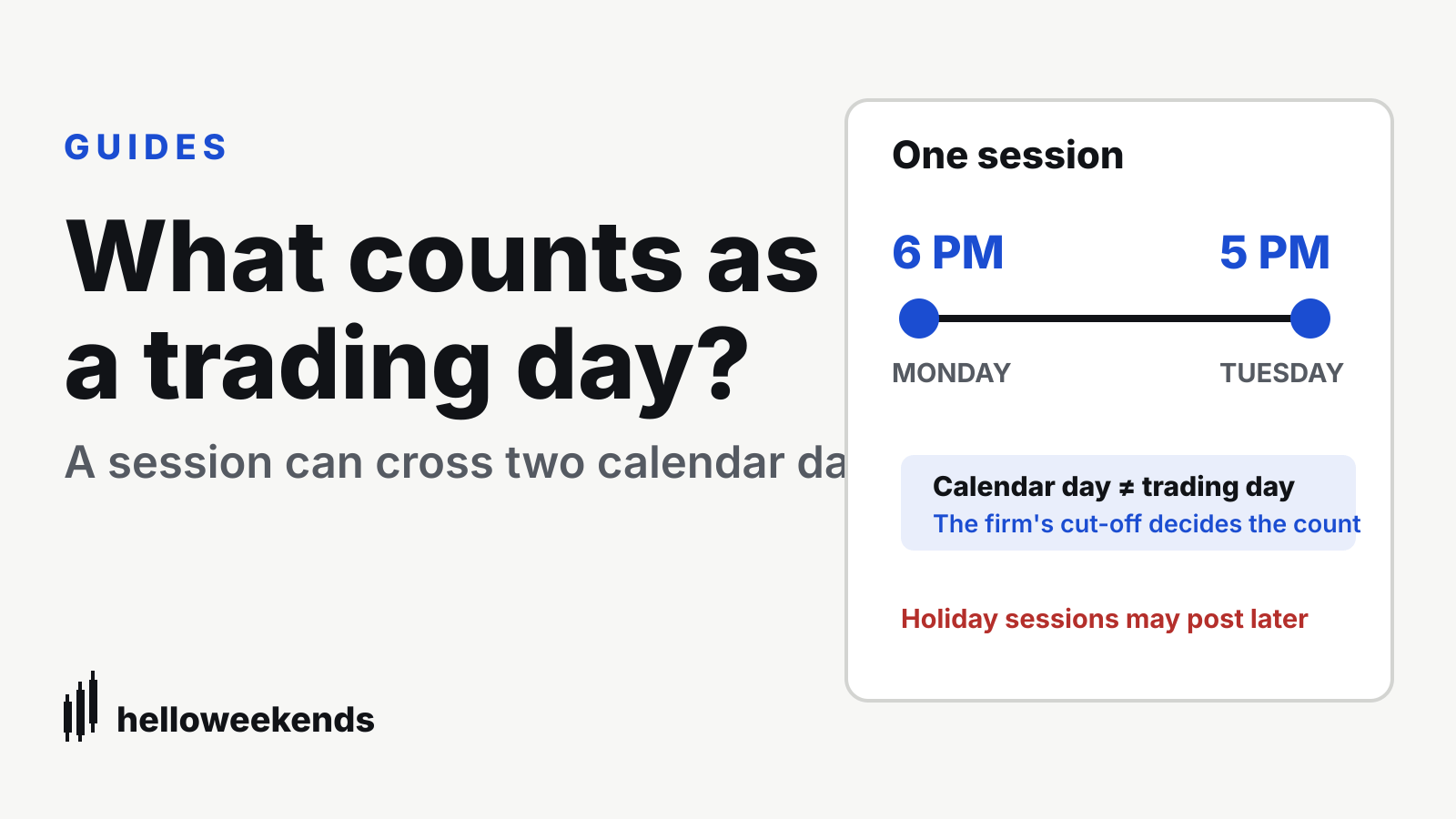
A session can cross two calendar dates and end before the exchange’s daily maintenance break. One calendar Tuesday can therefore contain the end of Tuesday’s trading session and the start of Wednesday’s.
Sources checked October 18, 2026. The examples below use the firms’ current public rules. Check the linked page because cutoffs and payout conditions can change.
Topstep says its Trading Combine day runs from 5:00 p.m. CT through 3:10 p.m. CT the next calendar day. A trade placed at 6:30 p.m. CT Tuesday is counted toward Wednesday’s activity. Its separate permitted-products page says positions must be closed by 3:10 p.m. CT each weekday and trading may resume at 5:00 p.m. CT. See Topstep’s Trading Combine parameters and permitted products and hours.
Tradeify uses Eastern Time. It says a trading day runs from 6:00 p.m. ET to 5:00 p.m. ET the following day. A trade at 10:00 a.m. and another at 7:00 p.m. on the same calendar date fall into two different trading days. See Tradeify’s official trading day definition.
These cutoffs are firm rules. They are not a universal exchange definition and they are not identical.
Imagine three trades:
| Calendar time | Firm session | Day credited |
|---|---|---|
| Monday 10:00 a.m. ET | Sunday evening–Monday close | Monday |
| Monday 7:00 p.m. ET | Monday evening–Tuesday close | Tuesday |
| Tuesday 2:00 p.m. ET | Monday evening–Tuesday close | Tuesday |
The first two trades occur on the same calendar date but belong to two sessions. The last two occur on different calendar dates but belong to one session.
That distinction matters for:
The reliable check is the firm’s stated session boundary. Do not infer it from the local date shown by the charting platform.
These labels answer different questions.
A calendar day is midnight to midnight in a chosen time zone. A trading day is the firm’s session window. A winning day is a trading day that also clears the firm’s profit condition. One trade may create activity for the session without creating a winning day.
This difference explains why a dashboard may show a new trading day but leave the payout counter unchanged. The account can have activity while falling below the winning-day threshold.
See minimum trading days for how session counts interact with consistency and payout rules.
A firm can require positions to be closed before the broader exchange session ends.
Topstep describes itself as a day-trading program. Its official page says positions must be closed by 3:10 p.m. CT, with risk managers beginning to flatten around 3:08 p.m. CT. If a product closes earlier, the trader must follow that product’s close.
Tradeify says all positions must be closed by 4:45 p.m. ET on regular days, before its 5:00–6:00 p.m. ET maintenance break. Its page says the rule applies to evaluation, simulated funded and live accounts. See the official Tradeify permitted trading times.
A platform accepting an order does not prove the firm permits the position. The firm’s flat-by rule controls the account.
Short holiday sessions need special attention. Tradeify says a Rithmic holiday half-day still counts as a trading day, but the credit may not appear until the next full market close. A Friday holiday half-day may therefore post on Monday.
This is an account-processing delay, not an extra session. Save the order history and wait for the published processing window before assuming the day was rejected.
For exchange schedules, use the CME holiday calendar 2026 or CME holiday calendar 2027. Firm cutoffs can be earlier than CME’s product close.
At the end of each session, keep four values:
Use the firm’s time zone, not a converted local date, as the primary record. If a result looks wrong, first check whether the trade occurred after the session rollover. Then check whether the rule requires any trade, a positive close or a minimum profit.
A simple spreadsheet is enough. The goal is to compare like with like, especially when a trader lives outside US Eastern or Central time.
An evening trade can start the next trading day while the calendar still shows today. That can help meet a day count, but it also starts a fresh risk period under some account rules. Review the daily loss and maximum loss definitions before placing it.
Read daily loss limit, trailing drawdown and futures market hours together. A day counter never overrides risk limits.
An evaluation is a paid service using simulated trading. Most participants do not pass. This is general information, not investment advice.
It can, if the plan defines a trading day by activity alone. A payout rule may additionally require a positive result or a minimum dollar profit.
Yes, if one is before the firm’s session cutoff and the other is after the next session opens. Tradeify gives a 10:00 a.m. and 7:00 p.m. ET example.
Not at the firms covered here. Topstep and Tradeify both require positions to be flat before their stated cutoff. Check the exact account plan.
Some platform and broker combinations post a shortened holiday session only after the next full close. Tradeify documents this behavior for Rithmic accounts.
The linked Topstep and Tradeify pages were checked on October 18, 2026.
